
Abstract
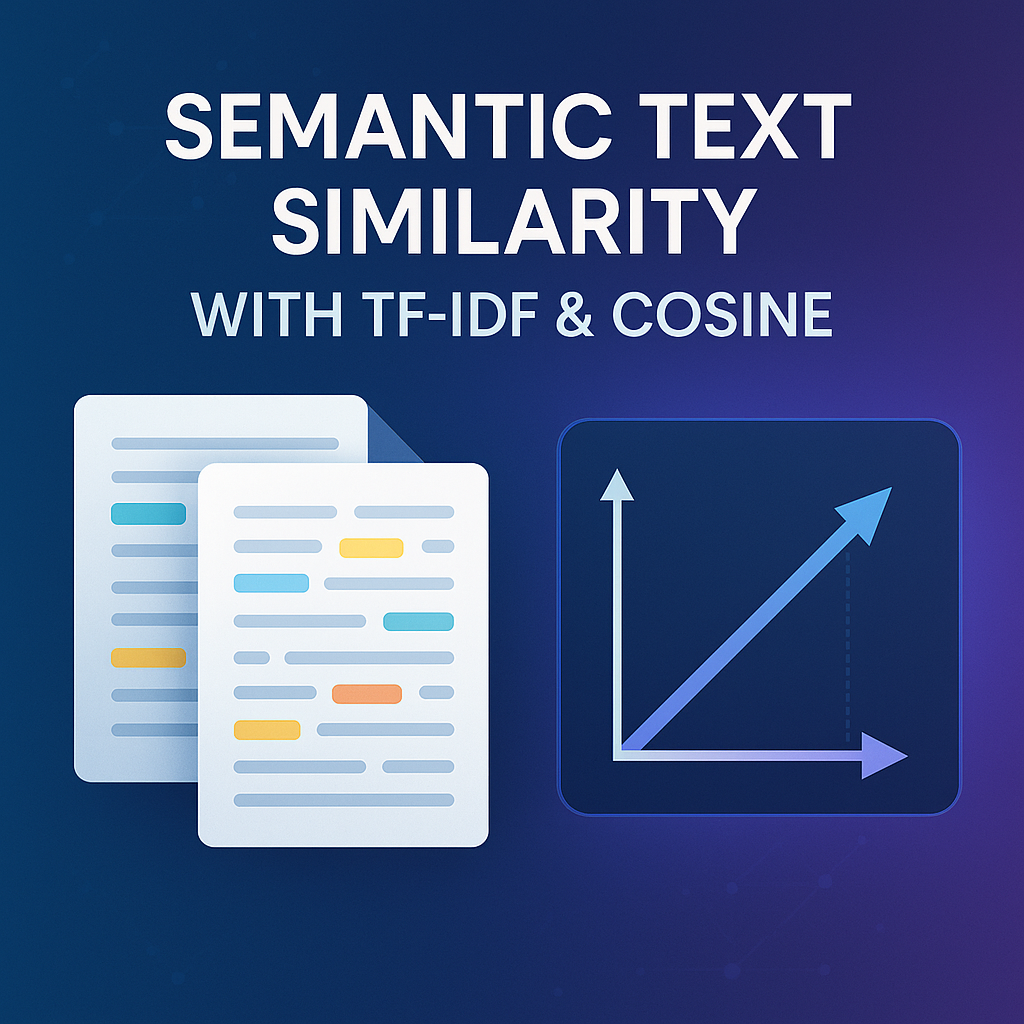
Text similarity measurement is an essential task in natural language processing (NLP), with applications in paraphrase detection, plagiarism detection, document clustering, and question-answering systems. This project aims to develop a system that evaluates the semantic similarity between two pieces of text using the Term Frequency-Inverse Document Frequency (TF-IDF) model combined with Cosine Similarity. By converting text into feature vectors and computing the cosine of athe angle between them, we can determine the degree of similarity. This approach provides an efficient and interpretable solution to measure textual similarity in various NLP applications.
Introduction
With the explosion of textual data across various domains, accurately assessing semantic similarity between texts has become crucial. Traditional lexical-based methods fail to capture contextual meaning, while deep learning models require extensive computational resources. TF-IDF is an effective weighting technique that enhances text representation, and cosine similarity is a robust measure for computing similarity between two text vectors. This project proposes a TF-IDF + Cosine Similarity approach to efficiently quantify textual similarity, making it suitable for various real-world NLP applications.
Problem Statement
Textual similarity measurement is challenging due to variations in word choice, sentence structure, and contextual meaning. Existing methods either lack semantic understanding or demand high computational power. The challenge is to develop an accurate and efficient similarity detection system that can be applied to diverse NLP applications such as document retrieval, plagiarism detection, and text summarization.
Existing System and Disadvantages
Existing approaches include Jaccard Similarity, Latent Semantic Indexing (LSI), and Deep Learning Models (e.g., BERT, SBERT). However, these methods have limitations, including lack of semantic awareness, high computational costs, and scalability issues.
Proposed System and Advantages
This project proposes a TF-IDF + Cosine Similarity approach. TF-IDF converts text into numerical feature vectors, highlighting important words, while Cosine Similarity calculates the similarity score between two text vectors based on their orientation in vector space. This approach is computationally efficient, interpretable, and scalable for various applications.
Modules
- Text Preprocessing: Tokenization, stopword removal, and stemming/lemmatization.
2. Feature Extraction: Converting text into TF-IDF feature vectors.
3. Similarity Computation: Applying cosine similarity to measure textual closeness.
4. Result Interpretation: Output similarity scores and visualization.
Workflow:
- User inputs Text-1 and Text-2.
- The system pre-processes the texts (tokenization, stopword removal, stemming/lemmatization).
- TF-IDF converts text into numerical vectors.
- Cosine Similar…
- The similarity percentage is displayed as output.
Algorithms
TF-IDF (Term Frequency – Inverse Document Frequency) and Cosine Similarity are used. TF-IDF computes a word’s importance in a document relative to a corpus, while Cosine Similarity measures the angle between two text vectors to determine their similarity.
Software and Hardware Requirements
Software: Python, scikit-learn, NLTK, NumPy, Pandas, Matplotlib.
Hardware: Intel Core i5 or higher, 8GB RAM, 20GB free space.
Conclusion and Future Enhancements
The project successfully implements a computationally efficient and interpretable system for measuring semantic textual similarity using TF-IDF and Cosine Similarity. Future enhancements include hybrid models combining TF-IDF with deep learning, semantic expansion using WordNet, real-time processing, and multilingual support.




Reviews
There are no reviews yet.