
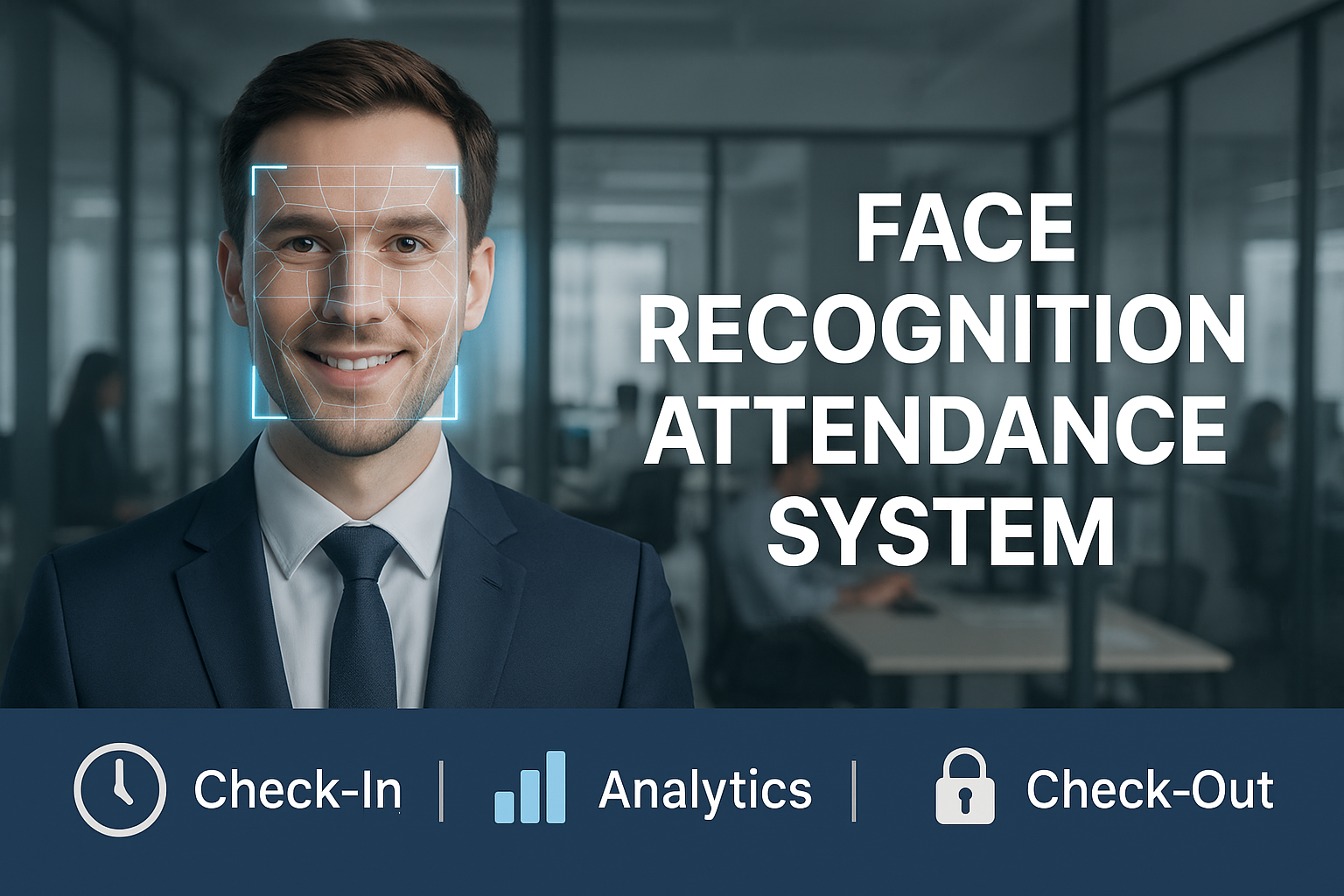
Employee Face Recognition Check-In/Check-Out Logging System with Role-Based Access and Attendance Analytics
Abstract
This project presents an advanced attendance management system leveraging face recognition technology to automate employee check-in and check-out processes. It incorporates role-based access control to support Admin, Employee, and HR roles, enabling secure authentication and management. The system captures facial images for training a convolutional neural network (CNN) model to accurately identify employees in real-time. Attendance records are maintained automatically upon successful recognition. Additionally, the system provides interactive graphical analytics using dynamic charts for attendance visualization tailored to each user role. This solution minimizes manual errors, enhances security, and simplifies attendance monitoring, offering a scalable and user-friendly interface suitable for organizations seeking efficient workforce management.
Introduction
Attendance management is critical for organizations to track employee presence and productivity. Traditional manual methods are error-prone, time-consuming, and vulnerable to fraudulent practices like proxy attendance. Recent advancements in computer vision and machine learning enable automated face recognition systems to improve accuracy and convenience. This project designs and implements an intelligent attendance system that integrates face recognition with role-based user access. Admins can manage users and train models, employees can perform attendance actions via face verification, and HR staff can review comprehensive attendance logs and analytics. The system employs CNN-based facial recognition, webcam integration for live detection, and interactive visualizations using Chart.js to provide insights into attendance patterns. This modern solution aims to streamline attendance processes, increase transparency, and support organizational efficiency.
Problem Statement
Manual attendance systems rely heavily on physical records or card-based punch-ins, leading to inefficiencies such as time wastage, data inaccuracies, and manipulation. The lack of automated verification mechanisms makes it difficult to ensure authentic attendance logging. Moreover, role-based access and data analytics are often missing, limiting administrative control and decision-making. There is a need for an automated, secure, and scalable attendance system that accurately identifies employees in real-time and provides role-specific access and insightful analytics.
Existing System
Many existing attendance systems use RFID cards, PIN codes, or biometric fingerprint scanners. These systems, although automated, can be costly to maintain and susceptible to proxy attendance (e.g., swapping cards). Some face recognition systems exist but often lack role-based access controls or advanced analytics. Many require expensive hardware or lack flexibility in user management and reporting.
Disadvantages of Existing System
- Prone to proxy attendance and fraudulent entries.
- Dependence on physical tokens like cards or biometric scanners.
- Limited role management and access control.
- Lack of real-time facial recognition in some solutions.
- Insufficient analytical tools to monitor attendance trends.
- High operational costs and maintenance overhead.
Proposed System
The proposed system integrates deep learning-based face recognition with a flexible role-based access control mechanism. Using a webcam, it captures employee faces for model training and real-time recognition during check-in/out. The system manages different user roles: Admin (manage users and models), Employee (mark attendance), and HR (view logs and analytics). Attendance data is automatically logged in CSV format. Interactive attendance analytics dashboards display user or organizational attendance trends via dynamic charts. The system is developed using Flask (backend), OpenCV, TensorFlow/Keras (face recognition), and Chart.js for frontend graphs. This ensures a cost-effective, scalable, and user-friendly attendance management solution.
Advantages
- Accurate and real-time face recognition for attendance.
- Role-based access enhances security and control.
- Automated attendance logging reduces errors and proxy attendance.
- Interactive graphs provide clear attendance insights by user or admin.
- Easy user management with admin registration and training modules.
- Webcam-based capture removes dependency on special hardware.
- Scalable and customizable to various organizational needs.
Modules
- User Management Module: Register users with roles and capture facial data for model training.
- Face Recognition Module: Train CNN model and perform real-time face recognition for attendance marking.
- Attendance Logging Module: Automatically record check-in/out times in daily CSV files.
- Role-Based Access Control Module: Control access for Admin, Employee, and HR dashboards.
- Analytics and Reporting Module: Generate dynamic attendance charts for admins, employees, and HR users.
- Authentication Module: Handle login with username, password, and face verification.
Algorithms:
- Convolutional Neural Network (CNN): Used for facial feature extraction and classification.
- Haar Cascade Classifier: For initial face detection from webcam frames.
- Categorical Cross-Entropy Loss: For multi-class face classification training.
- Adam Optimizer: For efficient model convergence.
- Data Pre-processing: Grayscale conversion, resizing, normalization.
Software Requirements
- Python 3.x
- Flask Web Framework
- OpenCV (cv2) for face detection and webcam integration
- TensorFlow / Keras for deep learning model creation and training
- Scikit-learn for data splitting and pre-processing
- Joblib for saving/loading label mappings
- Chart.js (via CDN) for dynamic frontend charts
- HTML/CSS/JavaScript for frontend interface
Hardware Requirements
- Computer with webcam capability for face capture and recognition
- Sufficient CPU/GPU resources to train and run CNN model efficiently (GPU recommended but not mandatory)
- Storage for face images dataset and attendance CSV files
Conclusion
This project successfully implements a robust face recognition attendance system integrated with role-based access and dynamic analytics. It automates attendance marking with high accuracy and ensures secure user authentication through facial verification. Role-specific dashboards improve system usability for admins, employees, and HR personnel. The visual attendance insights empower organizations to monitor and manage workforce presence effectively. This scalable solution addresses many shortcomings of traditional attendance systems, offering a modern, efficient alternative.
Future Enhancements
- Implement deep metric learning models (e.g., FaceNet) for improved recognition accuracy.
- Integrate mobile app support with camera-based attendance marking.
- Add SMS/email notifications for attendance confirmation.
- Incorporate multi-factor authentication for enhanced security.
- Support live alerts for absenteeism or late check-ins.
- Expand analytics with predictive attendance trends and anomaly detection.
- Integrate with payroll and leave management systems.



Reviews
There are no reviews yet.