
Abstract
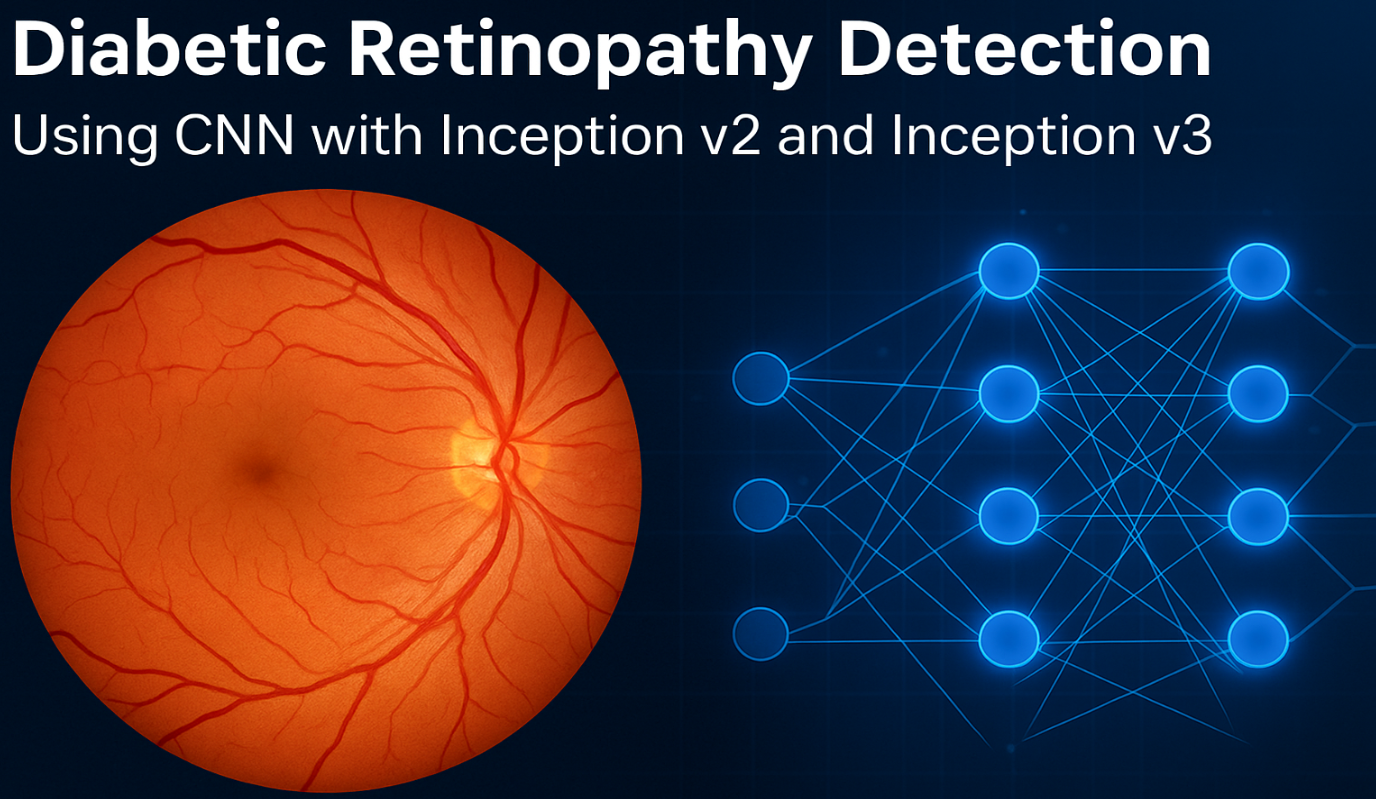
Diabetic Retinopathy (DR) is a complication of diabetes that affects the eyes, potentially leading to blindness if not diagnosed and treated early. Early detection and accurate classification of DR can significantly reduce the risk of vision loss. This project implements a Convolutional Neural Network (CNN) using Inception v2 and Inception v3 architectures to classify retinal images into five categories: Normal, Mild, Moderate, Severe, and Proliferative. The proposed model leverages the advanced feature extraction capabilities of Inception networks to achieve high accuracy. The system is trained and tested on publicly available datasets to evaluate performance and provide a robust solution for automated DR diagnosis.
Problem Statement
Diabetic Retinopathy is the leading cause of blindness among working-age adults. Manual examination of retinal images by ophthalmologists is time-consuming and prone to human error. An automated and accurate system for DR detection is essential to improve the speed and reliability of diagnosis. The goal of this project is to develop a CNN-based system using Inception v2 and Inception v3 architectures to automatically classify retinal images into five severity levels of DR, aiding in timely diagnosis and treatment.
Existing System and Disadvantages
Existing System
– Traditional Methods: Manual inspection of retinal images by ophthalmologists.
– Basic Image Processing and Machine Learning: Systems relying on hand-crafted features and traditional classifiers such as SVM and Decision Trees.
– Older CNN Models: Basic CNN architectures (e.g., AlexNet, VGG) with limited depth and feature extraction capabilities.
Disadvantages
- Time-Consuming: Manual diagnosis requires significant time and effort.
2. Prone to Errors: Human fatigue can lead to misdiagnosis.
3. Limited Accuracy: Traditional methods struggle to achieve high accuracy, especially with subtle variations in images.
4. Feature Limitations: Basic CNN models are not efficient at extracting complex patterns from high-resolution medical images.
Proposed System and Advantages
Proposed System
This project employs deep learning-based models using Inception v2 and Inception v3 architectures to classify retinal images into five DR severity levels. These architectures are known for their efficiency in capturing intricate patterns through their deeper layers and advanced feature extraction mechanisms. The model will be trained on a labelled dataset of retinal images and optimized for high accuracy and robustness.
Advantages
- High Accuracy: Inception v2 and v3 are powerful CNN architectures capable of accurate classification.
2. Automated Detection: Reduces the need for manual diagnosis, speeding up the process.
3. Feature-Rich Extraction: Efficient at identifying subtle patterns associated with different DR stages.
4. Scalability: Can handle large datasets and adapt to different image qualities.
5. Consistency: Provides consistent results without the variability seen in human diagnosis.
Modules
- Data Pre-processing
– Image resizing and normalization
– Data augmentation (rotation, flipping, brightness adjustments) - Model Development
– Implementing Inception v2 and Inception v3 CNN architectures
– Fine-tuning pre-trained models (transfer learning) - Training and Validation
– Splitting dataset into training, validation, and test sets
– Training the model and monitoring performance using accuracy and loss metrics - Evaluation and Testing
– Model evaluation using metrics like precision, recall, F1-score, and confusion matrix
– Testing on unseen data - Deployment
– Deploying the model using a web interface for real-time classification
– Integration of visualization tools for displaying predictions - Performance Analysis
– Comparative analysis of Inception v2 and Inception v3 models
– Visualization of feature maps and decision-making processes
Software Requirements
- Programming Language: Python
2. Frameworks: TensorFlow, Keras
3. Libraries:
– OpenCV (Image Processing)
– NumPy, Pandas (Data Manipulation)
– Matplotlib, Seaborn (Data Visualization)
4. IDE: Jupyter Notebook / PyCharm / Visual Studio Code
5. Operating System: Windows / Linux / macOS
Hardware Requirements
- Processor: Intel Core i5 or higher
2. RAM: 8GB or higher
3. GPU: NVIDIA GPU (GTX 1050 Ti or higher, for faster training)
4. Storage: 50GB or more (for datasets and model storage)



Reviews
There are no reviews yet.