
Abstract
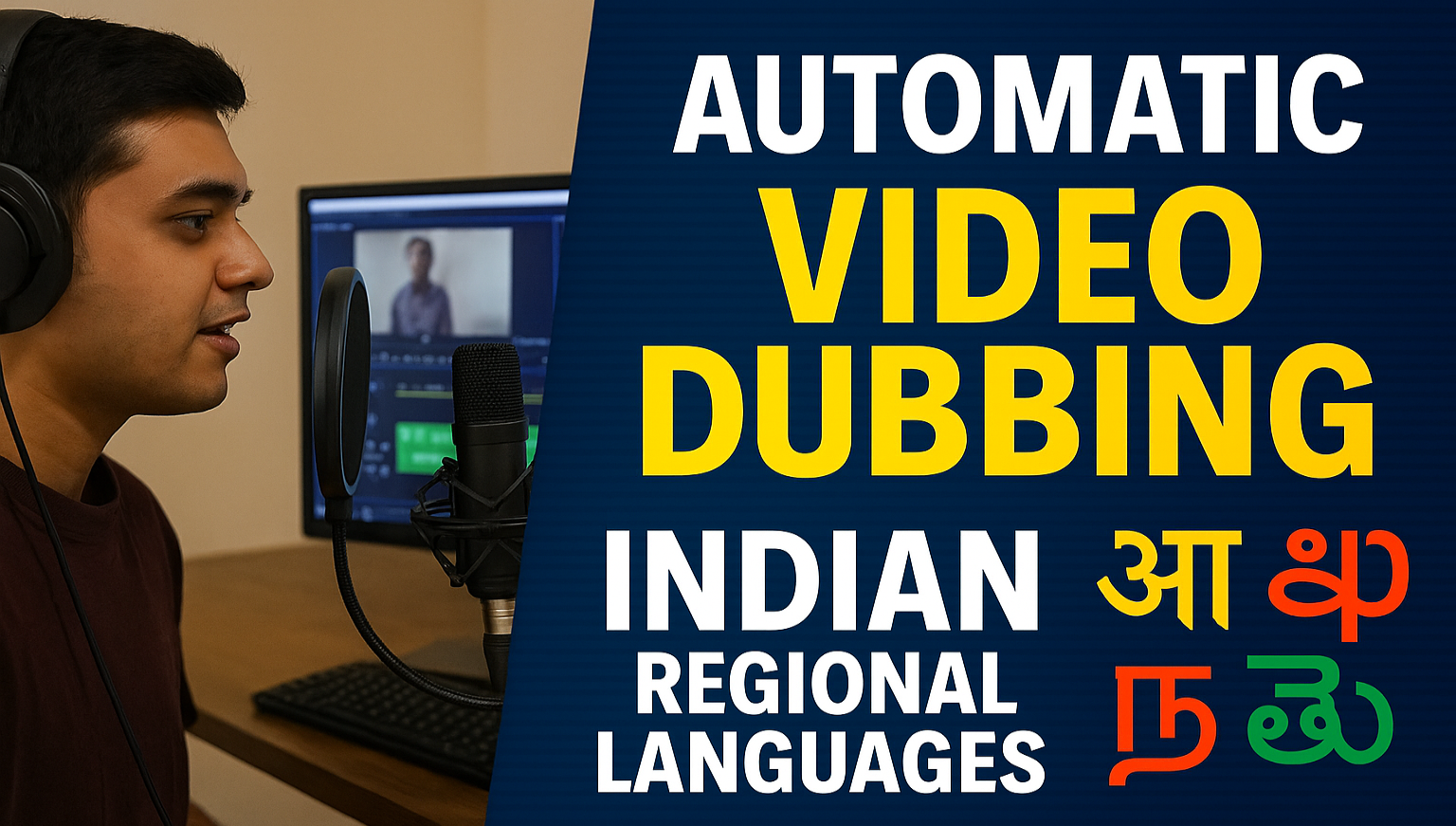
The growing demand for localized content in India necessitates the development of an automatic video dubbing system to cater to its diverse linguistic audience. This project leverages advanced technologies like Automatic Speech Recognition (ASR), Natural Language Processing (NLP), Text-to-Speech (TTS), and video processing to dub videos in various Indian regional languages. The system enables seamless translation, lip-syncing, and audio integration, making it a valuable tool for content creators, businesses, and educators aiming to reach multilingual audiences. The solution is cost-effective, scalable, and user-friendly, addressing language barriers effectively.
Problem Statement
Despite India’s linguistic diversity, many video creators struggle to provide localized versions of their content due to the high costs and time involved in manual dubbing. This hinders the accessibility of educational, entertainment, and commercial videos for audiences who prefer consuming content in their native languages.
Existing System and Disadvantages
Existing System
– Manual dubbing performed by professional voice artists.
– Subtitling as an alternative for localization.
– Use of basic translation tools without video integration.
Disadvantages
- Costly: Manual dubbing is expensive and time-intensive.
- Limited Accessibility: Subtitles do not address the needs of illiterate or visually impaired users.
- Poor Synchronization: Basic translation tools lack the capability for accurate lip-syncing and emotional tone.
- Scalability Issues: Inefficient for high-volume or dynamic content production.
Proposed System and Advantages
Proposed System
An automated video dubbing solution that integrates:
– Speech-to-text for transcript extraction.
– Accurate translation of transcripts into regional languages.
– Text-to-speech for generating natural-sounding audio in the target language.
– Video-audio synchronization for seamless integration.
Advantages
- Cost-Effective: Reduces the need for professional voice artists and manual labor.
- Scalable: Can handle large volumes of videos efficiently.
- Localized Experience: Provides native-language audio for better user engagement.
- Accessibility: Enhances content accessibility for visually impaired or illiterate audiences.
- Efficient: Produces high-quality output with minimal time investment.
Modules
- Video Upload and Analysis:
– Extract audio and detect key segments for processing.
2. Speech-to-Text (ASR):
– Converts spoken audio to text in the source language.
3. Language Translation:
– Translates the extracted text to the target regional language.
4. Text-to-Speech (TTS):
– Generates audio in the target language with accurate tone and emotion.
5. Audio-Video Synchronization:
– Merges the generated audio with the video while maintaining synchronization.
6. Output Generation:
– Encodes and saves the final dubbed video in a user-defined format.
Software and Hardware Requirements
Software Requirements
– Programming Language: Python
– Frameworks: Flask (backend), MoviePy, gTTS
– Operating System: Windows
Hardware Requirements
– Processor: Intel i5 or equivalent
– RAM: 8GB (minimum), 16GB (recommended)
– Storage: 100GB free space for video processing
– GPU: Dedicated GPU for faster video encoding (optional)
Reviews
There are no reviews yet.