
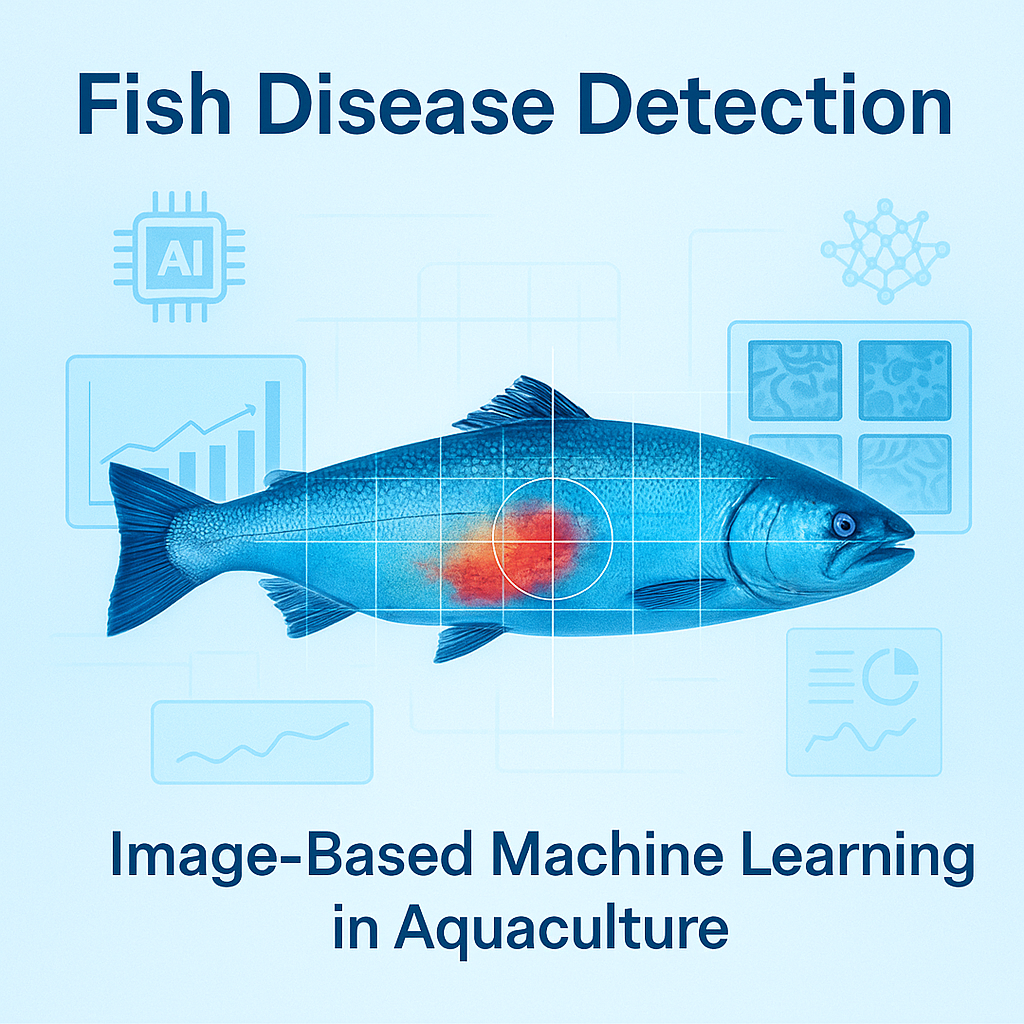
Fish Disease Detection Using Image-Based Machine Learning Technique in Aquaculture
Abstract
Fish diseases in aquaculture constitute a significant hazard to global food security and the aquaculture economy. Identifying infected fish at an early stage remains challenging due to the lack of necessary infrastructure and skilled manpower. In this work, we propose an image-based fish disease detection system that utilizes machine learning to classify infected and healthy fish. The system specifically focuses on salmon fish, as salmon aquaculture is one of the fastest-growing food production industries worldwide, contributing 70% (2.5 million tons) of the global market.
The proposed method combines advanced image pre-processing and Support Vector Machine (SVM) classification. Image enhancement and segmentation are performed using Cubic Spline Interpolation, Contrast Limited Adaptive Histogram Equalization (CLAHE), and LAB Color Segmentation with K-Means clustering. Extracted features are then used to train the SVM model to classify the fish as either healthy or infected. Experimental results show that the SVM-based model achieves high classification accuracy of 96%, outperforming other models such as Decision Tree, Logistic Regression, and Naïve Bayes.
Introduction
Aquaculture plays a vital role in meeting global food demand. However, fish diseases significantly affect fish production, leading to economic losses and threats to food security. Early detection of fish diseases is crucial to prevent outbreaks and minimize damage. Traditional manual methods of disease detection are time-consuming, subjective, and require expert knowledge.
Recent advancements in image processing and machine learning enable automated detection systems that can identify infected fish based on image data. The proposed system leverages machine learning algorithms to analyze visual characteristics of fish images and predict disease presence accurately. By integrating preprocessing techniques like Cubic Splines Interpolation, CLAHE, and LAB K-Means segmentation, the system enhances image quality and enables more effective feature extraction for classification.
Problem Statement
The identification of fish diseases in aquaculture is challenging due to:
- The absence of early-stage diagnostic infrastructure.
- Difficulty in manual inspection and subjectivity of results.
- Limited automation in aquaculture health monitoring systems.
Hence, there is a need for an automated and accurate image-based fish disease detection system that can classify healthy and infected fish efficiently using machine learning techniques.
Existing System
Previous research has attempted to identify fish diseases using basic image processing techniques.
- Shaveta et al. applied edge detection (Canny, Prewitt, Sobel) and feature extraction (HOG, FAST) for disease identification but lacked robustness in feature representation.
- Lyubchenko et al. used clustering-based segmentation but the method required manual marking, which was time-consuming.
- Malik et al. combined PCA, HOG, and FAST features with neural network classifiers, achieving around 86% accuracy for specific diseases.
Limitations of Existing Systems:
- Time-consuming manual operations.
- Inconsistent accuracy across datasets.
- Limited scalability and generalization for different fish species.
Disadvantages of Existing System
- Fish diseases continue to pose a significant hazard to food and economic security.
- Early detection of infected fish remains difficult due to inadequate infrastructure.
- Existing systems rely heavily on manual inspection and lack automation for large-scale aquaculture monitoring.
Proposed System
The proposed system introduces a machine learning-based fish disease detection framework that integrates advanced image preprocessing with Support Vector Machine (SVM) classification.
- Image preprocessing enhances quality using Cubic Splines Interpolation, CLAHE, and LAB K-Means segmentation.
- Extracted image features are used to train SVM, Decision Tree, Logistic Regression, and Naïve Bayes classifiers.
- Performance comparison is conducted among all algorithms, where SVM achieves the highest accuracy.
Key Features:
- Automated image-based disease identification.
- Improved accuracy through preprocessing and feature optimization.
- Scalable and adaptable to different fish species and datasets.
Advantages of Proposed System
- Enables early detection of fish diseases using automated image analysis.
- Reduces human intervention and diagnostic errors.
- Achieves high accuracy and reliability using the SVM model.
- Enhances image quality for precise feature extraction and classification.
- Facilitates efficient monitoring and management in aquaculture farms.
Modules
- Upload Fish Dataset
- Upload the fish image dataset containing “Fresh” and “Infected” categories.
- Run Interpolation, CLAHE & LAB
- Apply image preprocessing techniques:
- Cubic Spline Interpolation for magnification and resizing.
- CLAHE for contrast enhancement.
- LAB K-Means Segmentation for color-based segmentation.
- Apply image preprocessing techniques:
- Run Decision Tree
- Train Decision Tree classifier and evaluate accuracy metrics.
- Run Logistic Regression
- Train Logistic Regression model and compute accuracy and confusion matrix.
- Run Naïve Bayes
- Train Naïve Bayes model for probabilistic classification.
- Run Proposed SVM Algorithm
- Train SVM classifier on processed image data and predict fish disease status.
- Comparison Graph
- Compare performance (accuracy, precision, recall, F1-score) of all models.
- Predict Fish Status
- Upload a new test image to predict whether the fish is “Fresh” or “Infected.”
Algorithms Used
- Cubic Splines Interpolation
- Used for image magnification and uniform resizing.
- Maintains smooth pixel intensity transitions.
- CLAHE (Contrast Limited Adaptive Histogram Equalization)
- Enhances local image contrast and highlights disease spots.
- Prevents overamplification of noise.
- LAB K-Means Segmentation
- Converts image from RGB to LAB color space.
- Groups similar colors into clusters to isolate disease-affected areas.
- Support Vector Machine (SVM)
- A supervised learning algorithm used for classification.
- Finds the optimal hyperplane separating infected and healthy fish.
- Achieved 96% accuracy, outperforming Decision Tree, Logistic Regression, and Naïve Bayes.
System Requirements
Hardware Requirements
- Processor: Minimum Intel i3 or above
- RAM: 4 GB or higher
- Hard Disk: 40 GB minimum
- Display: 1024×768 resolution
Software Requirements
- Operating System: Windows 8 or higher
- Programming Language: Python 3.7+
- Libraries Used: OpenCV, Scikit-learn, NumPy, Matplotlib, Pandas
- IDE: PyCharm / VS Code / Jupyter Notebook
Conclusion
The proposed system successfully automates the process of fish disease detection in aquaculture using image-based machine learning techniques. By applying image preprocessing methods such as Cubic Splines Interpolation, CLAHE, and LAB segmentation, and using SVM for classification, the system achieves a high accuracy of 96%. Compared to traditional models like Decision Tree, Naïve Bayes, and Logistic Regression, the SVM model delivers superior results in terms of accuracy and reliability. This system helps aquaculture industries monitor fish health efficiently and prevent large-scale disease outbreaks.
Future Enhancement
- Integrate deep learning models such as CNNs for end-to-end disease detection.
- Develop a mobile or web-based application for real-time monitoring in aquaculture farms.
- Expand the system to include multiple fish species and diseases.
- Integrate IoT sensors and water quality monitoring for holistic fish health prediction.
- Enable cloud-based dataset management for large-scale deployment.


Reviews
There are no reviews yet.