
Abstract
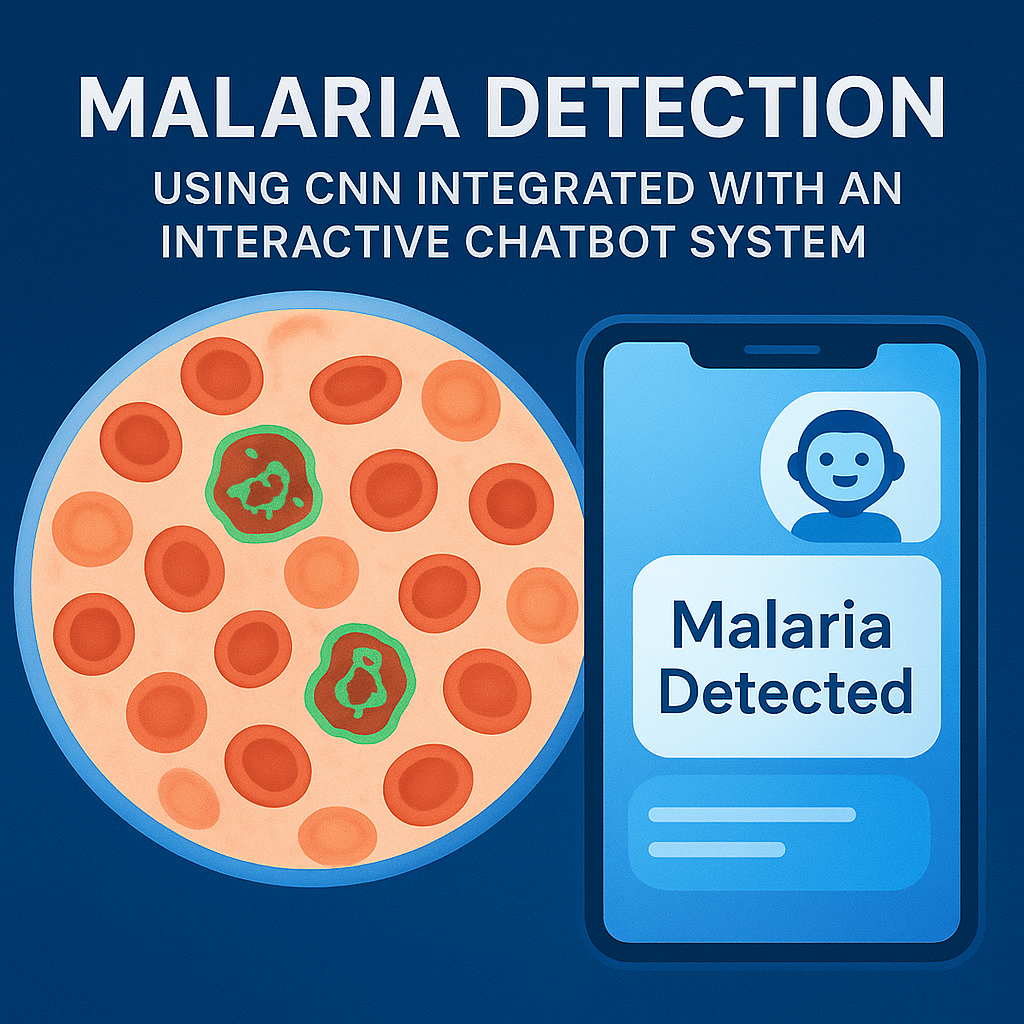
Malaria remains a significant global health challenge, particularly in tropical and subtropical regions. Early and accurate detection of malaria-infected cells can enhance treatment efficacy and reduce mortality rates. This project utilizes Convolutional Neural Networks (CNN) to classify microscopic images of cells as infected or uninfected. The system integrates a user-friendly chatbot to provide additional assistance by collecting patient symptoms, medical history, and offering basic medication guidance. The proposed approach aims to enhance diagnostic accuracy and accessibility, assisting medical professionals and individuals in early-stage malaria detection and guidance.
Introduction
Malaria is a life-threatening disease caused by Plasmodium parasites transmitted through the bites of infected female Anopheles mosquitoes. Traditional diagnostic methods, such as microscopic examination and rapid diagnostic tests, require skilled personnel and can be time-consuming. Artificial Intelligence (AI) and deep learning techniques, particularly Convolutional Neural Networks (CNN), have demonstrated potential in medical imaging and disease diagnosis. This project leverages CNN models, including Basic CNN, VGG-19 Frozen CNN, and VGG-19 Fine-Tuned CNN, to classify cell images as infected or uninfected. Additionally, the system incorporates a chatbot to assist users by collecting symptoms, medical history, and providing preliminary medical advice.
Problem Statement
Malaria detection in underdeveloped regions is often delayed due to a lack of medical resources and expertise. Manual diagnosis is prone to errors, leading to misdiagnosis and ineffective treatments. A system capable of automated, accurate malaria detection integrated with a chatbot for patient assistance can significantly improve early diagnosis and management.
Existing System and Disadvantages
– Traditional microscopy-based malaria diagnosis relies on skilled personnel and is time-intensive.
– Rapid diagnostic tests (RDTs) are available but can yield false positives or negatives.
– Machine learning models have been explored for malaria detection, but many lack an interactive interface for patient assistance.
– Existing AI-based systems do not provide real-time user support for symptom assessment and basic medical guidance.
Proposed System and Advantages
– Utilizes CNN models to classify cell images as infected or uninfected with high accuracy.
– Incorporates a chatbot system to interact with users, collecting symptoms and medical history.
– Provides basic medical guidance based on user inputs, improving accessibility to preliminary healthcare.
– Reduces dependency on skilled professionals for initial malaria diagnosis.
– Enhances early detection, leading to timely treatment and better patient outcomes.
Modules
- Data Pre-processing – Image augmentation and dataset preparation.
- Model Training – Training CNN models (Basic CNN, VGG-19 Frozen CNN, VGG-19 Fine-Tuned CNN) on malaria dataset.
- Malaria Detection – Predicts whether a given cell image is infected or uninfected.
- User Interface – Displays prediction results and allows user interaction.
- Chatbot System – Engages with users to collect symptoms, medical history, and provide basic guidance.
- Integration – Combines malaria detection model with chatbot for a seamless experience.
Algorithms
– Basic CNN: A simple convolutional neural network model for initial classification.
– VGG-19 Frozen CNN: A pre-trained model with frozen layers for feature extraction.
– VGG-19 Fine-Tuned CNN: A fine-tuned VGG-19 model with trainable layers for improved performance.
Software and Hardware Requirements
– Software: Python, TensorFlow/Keras, OpenCV, Flask/Django (for web interface), Dialogflow/Custom NLP for chatbot.
– Hardware: High-performance GPU for model training, minimum 8GB RAM, storage for dataset handling.
Conclusion and Future Enhancement
This project provides an AI-powered malaria detection system integrated with a chatbot for user assistance. By leveraging deep learning techniques, the system enhances diagnostic accuracy and accessibility, particularly in resource-limited areas. Future enhancements may include:
– Integration with mobile applications for real-time malaria detection.
– Expansion to detect multiple diseases using a multi-class classification model.
– Improvement of chatbot capabilities with AI-driven personalized recommendations.
– Addition of multilingual support to enhance usability in different regions.


Reviews
There are no reviews yet.