
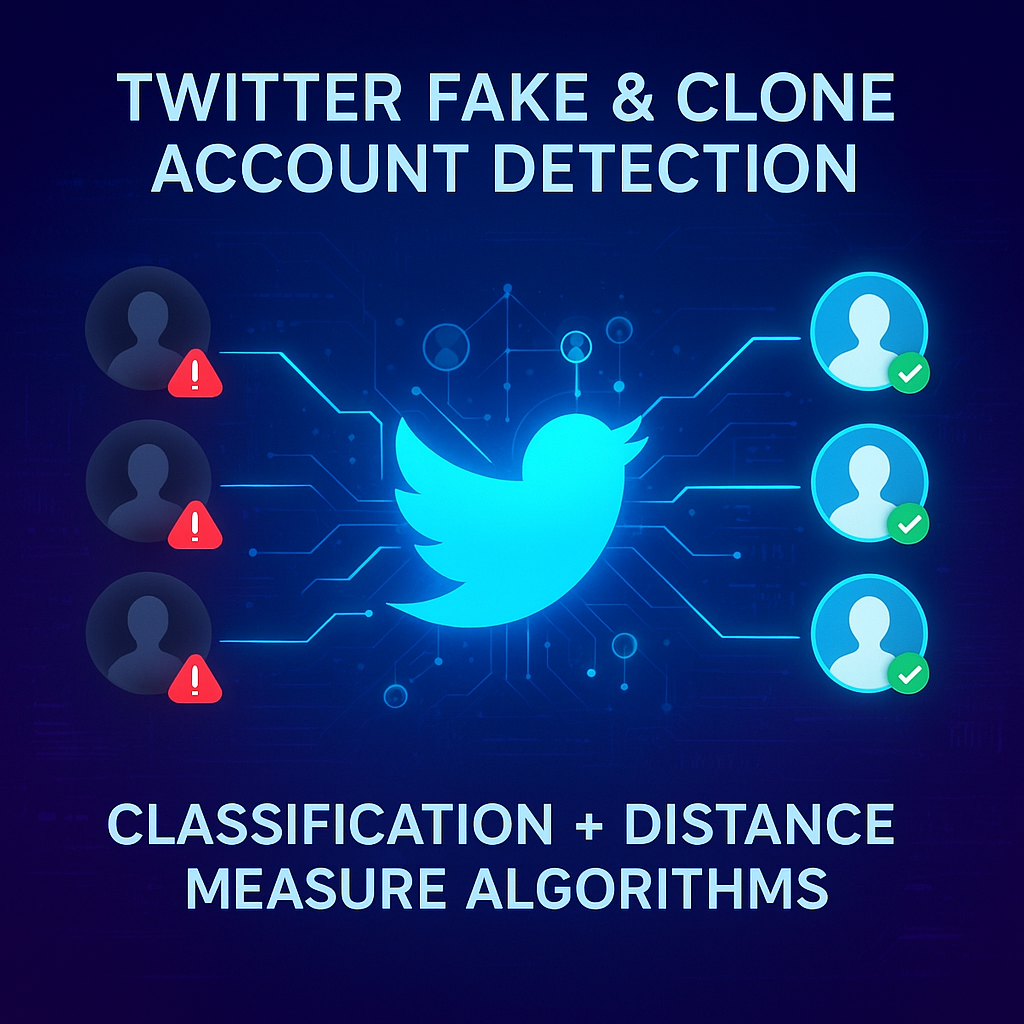
Detection of Fake and Clone Accounts in Twitter using Classification and Distance Measure Algorithms
Abstract
With the rapid growth of social media, platforms like Twitter have become vulnerable to fake and clone accounts that spread misinformation, phishing links, and spam. This project presents a hybrid framework combining machine learning classification algorithms (Support Vector Machine, Decision Tree, Random Forest) with distance-based measures to accurately detect and flag fake and cloned Twitter accounts. By extracting behavioral, profile, and network-based features from user data, the system trains multiple classifiers and applies a distance-measure module to catch subtle clones. Experimental results demonstrate high accuracy and recall, showcasing the effectiveness of ensemble approaches in securing online communities.
Introduction
Twitter’s open nature makes it easy for malicious actors to create fake or clone accounts that impersonate legitimate users or organizations. These accounts can damage reputations, deceive followers, and propagate harmful content. While individual classification models have been applied to detect such accounts, they often struggle with sophisticated clones that closely mimic genuine behaviors. This project leverages a multi-pronged strategy:
- Feature Extraction: Gather profile features (username similarity, bio length, verification status), behavioral features (tweet frequency, retweet patterns), and network features (follower-following ratios, mutual connections).
- Classification Models: Train and compare SVM, Decision Tree, and Random Forest classifiers on labeled datasets of real vs. fake/clone accounts.
- Distance-Measure Module: Compute string and behavioral similarity scores (e.g., cosine similarity, Levenshtein distance) between candidate accounts and known genuine profiles to catch near-identical clones.
- Ensemble Decision: Combine classification predictions with distance-based flags to improve detection robustness.
Problem Statement
Malicious entities exploit automated account creation to generate fake or clone Twitter profiles that resemble real users. Existing detection systems based solely on classification often fail when clones imitate legitimate users’ attributes closely. There is a critical need for an integrated framework that combines classification algorithms with distance-based measures to improve detection accuracy, particularly against sophisticated cloning attacks.
Existing System and Disadvantages
- Rule-Based Filters: Rely on static thresholds (e.g., minimum tweet count), leading to high false positives/negatives.
- Single Classifier Approaches: Use one model type (e.g., only Random Forest), which can overfit or underperform on certain data distributions.
- Limited Feature Sets: Focus primarily on profile features, ignoring behavioral and network anomalies.
Disadvantages:
- Poor adaptability to evolving clone tactics
- High error rates for accounts that closely mimic genuine users
- Inability to capture nuanced similarity metrics
Proposed System and Advantages
- Hybrid Detection: Combines three classifiers (SVM, Decision Tree, Random Forest) to leverage their complementary strengths.
- Distance Measures: Incorporates string- and behavior-based similarity scoring to flag clones that classification alone might miss.
- Rich Feature Set: Utilizes profile, behavioral, and network features for holistic detection.
- Ensemble Voting: Merges classifier outputs with distance flags to reduce false alarms and improve recall.
Advantages:
- Higher overall accuracy and robustness
- Improved detection of sophisticated clones
- Scalable to large Twitter datasets
Modules
- Data Collection Module
- Use Twitter dataset to fetch user profiles, tweets, and follower networks.
- Preprocessing Module
- Clean text, normalize usernames, handle missing values.
- Feature Extraction Module
- Derive profile, behavioral, and network features.
- Model Training Module
- Train SVM, Decision Tree, and Random Forest classifiers.
- Distance-Measure Module
- Compute Levenshtein distance for usernames, cosine similarity for tweet embeddings.
- Ensemble Decision Module
- Combine classifier predictions with distance thresholds to flag suspicious accounts.
- Evaluation Module
- Compute metrics (accuracy, precision, recall, F1-score) and generate ROC curves.
Algorithms / Models
- Support Vector Machine (SVM): Effective for high-dimensional feature spaces.
- Decision Tree: Interpretable model that handles categorical features well.
- Random Forest: Ensemble of Decision Trees for improved generalization.
- Levenshtein Distance: Measures string similarity between usernames.
- Cosine Similarity: Assesses similarity between tweet embedding vectors.
Software and Hardware Requirements
| Component | Specification |
| Software | Python 3.8+, scikit-learn, pandas, NumPy, Tweepy, NLTK, gensim |
| Development IDE | PyCharm / VS Code |
| Operating System | Windows 10 / Linux Ubuntu 20.04 |
| Hardware | CPU: Quad-core i5 or higher; RAM: 16 GB; Disk: 100 GB SSD |
| Optional | GPU (for large-scale embedding training) |
Conclusion
This project demonstrates that a hybrid approach—integrating multiple classification algorithms with distance-based detection—significantly enhances the identification of fake and clone Twitter accounts. The ensemble strategy reduces both false positives and false negatives, outperforming single-model systems.
Future Enhancement
- Deep Learning Models: Integrate LSTM/CNN-based sequence models for tweet content analysis.
- Real-Time Monitoring: Deploy the system as a streaming pipeline to detect suspicious accounts as they emerge.
- Adaptive Thresholds: Use reinforcement learning to dynamically adjust distance-measure thresholds based on feedback.
- Multi-Platform Extension: Extend detection to other social networks (Facebook, Instagram).
- User Feedback Loop: Incorporate crowd-sourced validation to refine model performance.



Reviews
There are no reviews yet.