
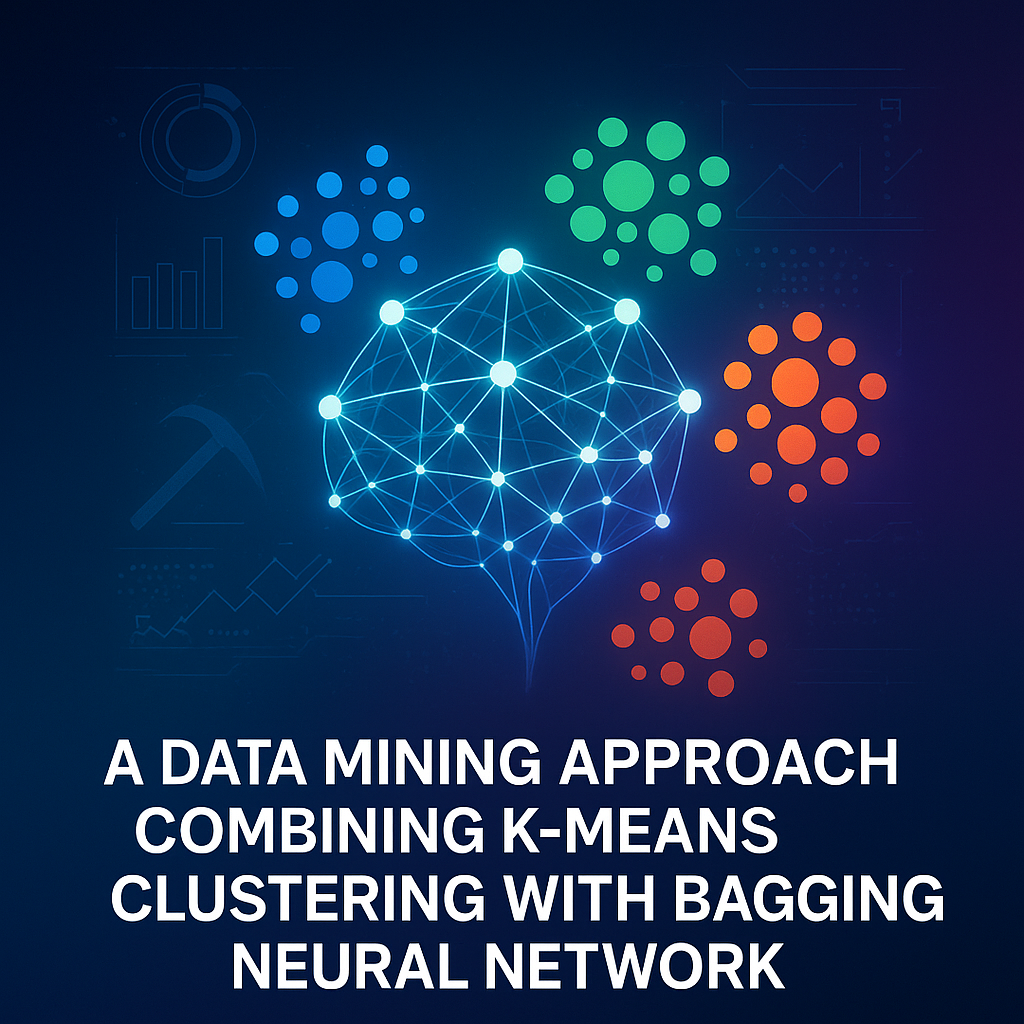
A Data Mining Approach Combining K-Means Clustering with Bagging Neural Network for Weather Forecasting
Abstract
Accurate weather forecasting is critical for agriculture, disaster management, aviation, and many other sectors. Traditional numerical and single-model machine learning approaches often struggle with nonlinearity, noise, and variability inherent in meteorological data. This project proposes a hybrid data-driven framework that first segments historical weather observations into homogeneous clusters using K-Means clustering and then trains an ensemble of neural networks via bagging on each cluster. By reducing within-cluster variance and leveraging ensemble learning to minimize model variance, the proposed system delivers more reliable short-term forecasts of temperature, humidity, and rainfall. A Flask-based web interface backed by a MySQL database provides real-time predictions and visualization.
Introduction
Weather forecasting traditionally relies on computationally intensive numerical models that simulate atmospheric physics. More recently, data-driven methods—particularly artificial neural networks (ANNs)—have shown promise by learning nonlinear relationships directly from historical observations. However, single ANN models can suffer from overfitting and high variance, especially when trained on highly heterogeneous datasets. Clustering methods like K-Means can partition data into more uniform subsets, reducing noise and improving model focus. Ensemble techniques such as bagging further enhance robustness by aggregating multiple models trained on bootstrap samples. This project integrates these two strategies—K-Means clustering and bagging neural networks—to build a hybrid forecasting system that balances bias and variance, improving accuracy and stability in short-term weather predictions.
Problem Statement
- Heterogeneity: Meteorological datasets contain a mix of seasonal patterns, extreme events, and regional variations that single-model approaches struggle to capture.
- High Variance: ANNs trained on raw data can overfit to noisy observations, leading to erratic forecasts.
- Computational Cost: Numerical weather models require extensive computational resources and domain expertise.
- Accessibility: There is a need for a lightweight, data-driven forecasting tool that can be deployed on commodity hardware with an intuitive web interface.
Existing System & Disadvantages
- Numerical Weather Prediction (NWP) Models
- Disadvantages: High computational cost; long processing times; require specialized meteorological expertise.
- Single ANN-Based Models
- Disadvantages: Prone to overfitting; sensitive to noisy and heterogeneous data; lack robustness to outliers.
- Statistical Time Series Models (ARIMA, SARIMA)
- Disadvantages: Assume stationarity; limited capability to model complex nonlinear relationships; manual parameter tuning.
Proposed System & Advantages
- System Overview:
- Data Ingestion: Historical weather data (temperature, humidity, rainfall) stored in MySQL.
- Pre-processing: Cleaning, normalization, feature engineering (lags, rolling statistics).
- Clustering: K-Means groups similar weather regimes to reduce intra-group variance.
- Model Training: For each cluster, train multiple instances of a feedforward neural network on bootstrapped samples (bagging).
- Ensemble Prediction: Aggregate outputs (e.g., average) from the bagged ensemble within the matching cluster.
- Deployment: Flask app serves forecasts via RESTful API and web dashboard.
- Advantages:
-
- Reduced Variance: Bagging minimizes fluctuations across individual model predictions.
- Noise Reduction: Clustering isolates homogeneous patterns, filtering out disruptive variability.
- Modularity: Separate clusters allow targeted model retraining without impacting the entire system.
- Scalability: New clusters or additional neural networks can be added as more data become available.
- User-Friendly: Web interface for non-technical stakeholders to obtain forecasts and visualizations.
Modules
- Data Acquisition Module
- Connects to APIs or CSV/JSON feeds to pull historical and real-time weather data.
- Stores raw data in a MySQL database.
- Data Preprocessing Module
- Handles missing values, outlier detection, normalization, and feature extraction (e.g., rolling means).
- Clustering Module
- Implements K-Means clustering to partition preprocessed data into k clusters based on feature similarity.
- Persist cluster centroids and assignments in the database.
- Model Training Module
- For each cluster:
- Draw n bootstrap samples.
- Train a feedforward neural network on each sample.
- Save trained model weights.
- For each cluster:
- Prediction Module
- Assigns incoming data to the nearest cluster.
- Loads the bagged ensemble for that cluster and computes the aggregated forecast.
- Web Application Module
- Flask back end providing RESTful endpoints for forecast requests.
- HTML/JavaScript front end for interactive charts (temperature curve, humidity trends, rainfall probability).
- Database Module
- MySQL schema to store raw and processed data, cluster metadata, model parameters, and forecast logs.
Algorithms
- K-Means Clustering
- Randomly initialize k centroids.
- Assign each data point to the nearest centroid.
- Recompute centroids as the mean of assigned points.
- Repeat steps 2–3 until convergence (no change in assignments or max iterations reached).
- Bagging Neural Network
- For i in 1…N (number of bagged models):
- Draw a bootstrap sample (with replacement) from the cluster’s training set.
- Train a feedforward neural network on the sample (e.g., 3 hidden layers with ReLU activations).
- At inference, average predictions across all N models to obtain the final forecast.
- For i in 1…N (number of bagged models):
Software Requirements
- Programming Language & Libraries
- Python 3.8+
- scikit-learn (for K-Means)
- TensorFlow 2.x or PyTorch (for neural networks)
- NumPy, Pandas (data manipulation)
- Matplotlib or Plotly (visualization)
- Web Framework
- Flask 2.x
- Flask-RESTful (optional)
- Database
- MySQL 5.7+
- mysql-connector-python or SQLAlchemy
Hardware Requirements
- Processor: Intel Core i5 (4-core) or equivalent
- Memory: ≥ 8 GB RAM (16 GB recommended for large datasets)
- Storage: ≥ 256 GB SSD (for database and model storage)
- GPU (optional): NVIDIA GPU with CUDA support (e.g., GTX 1660) to accelerate neural network training
- Network: Broadband internet connection for real-time data ingestion
Conclusion
This hybrid data mining framework leverages unsupervised clustering to tame the heterogeneity of weather data and ensemble learning to reduce model variance. By combining K-Means clustering with a bagged neural network ensemble, the system delivers more accurate and stable short-term forecasts compared to standalone methods. The modular architecture and Flask-based deployment facilitate easy extension, maintenance, and interactive use by stakeholders.
Future Enhancements
- Dynamic k Selection: Implement methods (e.g., silhouette analysis, elbow method) to adaptively choose the optimal number of clusters.
- Additional Ensembles: Incorporate boosting (e.g., AdaBoost) or stacking ensembles for further performance gains.
- Deep Clustering: Explore autoencoder-based clustering to learn more expressive feature embeddings.
- Real-Time Streaming: Integrate Apache Kafka or similar platforms for scalable, low-latency data pipelines.
- Expanded Variables: Include wind speed, solar radiation, and pressure data to enrich forecast granularity.
- Mobile App: Develop a companion mobile application for push notifications of critical weather alerts.



Reviews
There are no reviews yet.