
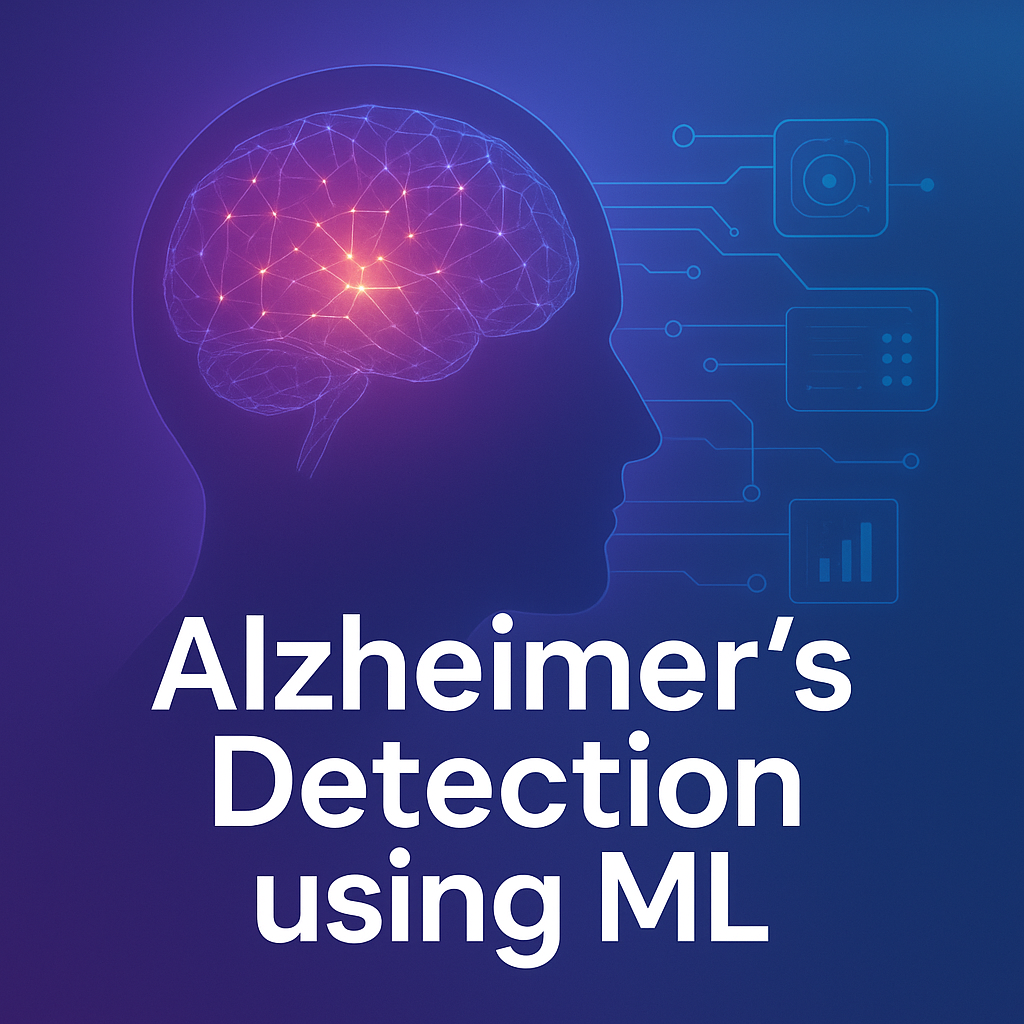
Early Detection of Alzheimer’s Disease Using SVM Machine Learning Algorithm
Abstract
Alzheimer’s Disease (AD) is a progressive neurodegenerative disorder that primarily affects older adults, causing memory loss and cognitive decline. Early detection of AD can significantly improve the quality of life for patients by enabling timely interventions and care planning. This project proposes a machine learning-based diagnostic system utilizing Support Vector Machine (SVM) to classify individuals at risk of Alzheimer’s Disease. Using the comprehensive Alzheimer’s Disease Dataset from Kaggle, the system is trained and evaluated for prediction accuracy. The project includes the integration of a Flask-based web interface for user-friendly interaction and data submission, and a MySQL database for secure data storage and management. Experimental results demonstrate the effectiveness of SVM in distinguishing between different stages of AD, providing a scalable, accessible, and reliable tool for early detection and decision support in clinical and community settings.
Introduction
Alzheimer’s Disease (AD) is one of the most prevalent forms of dementia, contributing to 60-70% of cases globally. The absence of a cure and the progressive nature of AD make early diagnosis and intervention critical for patient care. Conventional diagnostic methods, such as neuroimaging and cognitive testing, are often expensive, invasive, and time-consuming. With advancements in machine learning and data availability, predictive modeling has emerged as a valuable approach for non-invasive, efficient, and accurate diagnosis. This project leverages the Alzheimer’s Disease Dataset from Kaggle, which comprises demographic, cognitive, and imaging data, to develop a machine learning-based detection system. By implementing the SVM algorithm, the system aims to classify subjects into cognitive normal (CN), mild cognitive impairment (MCI), or Alzheimer’s Disease (AD) categories. The platform provides an interactive web application for healthcare professionals and caregivers to submit patient data and receive instant diagnostic predictions. The end-to-end system is designed for robustness, scalability, and ease of use, supporting the broader goal of integrating AI into routine healthcare workflows for neurodegenerative disease management.
Problem Statement
Early and accurate diagnosis of Alzheimer’s Disease remains a significant challenge in clinical practice due to the disease’s heterogeneous progression, overlapping symptoms, and limited access to advanced diagnostic tools. Existing manual and semi-automated diagnostic procedures are often subjective, resource-intensive, and not readily available in under-resourced regions. There is an urgent need for a reliable, scalable, and user-friendly solution that leverages existing patient data to predict Alzheimer’s Disease at an early stage, facilitating timely interventions and care.
Existing System and Disadvantages
Existing System:
- Traditional Diagnosis: Relies on a combination of neuropsychological tests, neuroimaging (MRI/PET), blood biomarkers, and genetic analysis.
- Manual Assessment: Clinical evaluation by neurologists and specialists.
- Semi-automated Tools: Some digital cognitive assessment platforms exist but lack integration with predictive analytics or databases.
Disadvantages:
- Time-consuming and Expensive: Neuroimaging and genetic testing are costly and not universally available.
- Subjectivity: Manual cognitive assessments can be influenced by examiner bias.
- Limited Scalability: Not suitable for mass screening or use in primary healthcare settings.
- Delayed Diagnosis: Patients often diagnosed at a moderate or advanced stage, reducing intervention effectiveness.
Proposed System and Advantages
Proposed System:
- A machine learning-based web application that predicts Alzheimer’s Disease stage using SVM, powered by data from the Kaggle Alzheimer’s dataset.
- User interface for data entry, real-time prediction, and historical record management.
- Back-end storage using MySQL for persistence and future analytics.
Advantages:
- Speed and Efficiency: Provides instant predictions for large volumes of data.
- Non-invasive: Uses demographic and clinical data, minimizing the need for costly imaging or invasive procedures.
- Accessibility: Usable by clinicians and caregivers from any location with internet access.
- Objectivity and Consistency: Reduces human bias and variability in diagnosis.
- Scalability: Can be deployed in both small clinics and large hospitals.
- Data-Driven: Continuously improves as more data is collected and analyzed.
Modules
- Data Collection Module
- Collects patient demographic and clinical data.
- Supports CSV and manual entry via web form.
- Data Preprocessing Module
- Handles missing values, normalization, and encoding of categorical variables.
- Feature Selection Module
- Selects the most relevant features for SVM training.
- Model Training and Evaluation Module
- Trains the SVM classifier and evaluates using accuracy, precision, recall, F1-score.
- Prediction and Result Module
- Accepts new input and predicts the AD stage.
- Displays predictions and model performance metrics.
- Web Application Interface Module
- Flask-based front end for user interaction.
- Secure login and session management.
- Database Module
- MySQL-based storage for user input, predictions, and logs.
Algorithms:
- Support Vector Machine (SVM) Classifier:
- Used for multi-class classification (CN, MCI, AD).
- Finds the optimal hyperplane to separate classes in high-dimensional space.
- Effective for smaller, well-structured clinical datasets.
- Evaluation Metrics:
- Accuracy, Precision, Recall, F1-Score, Confusion Matrix
Software and Hardware Requirements
Software Requirements:
- Programming Language: Python 3.x
- Libraries: pandas, numpy, scikit-learn, Flask, matplotlib, joblib
- Database: MySQL
- Web Framework: Flask
- Other: HTML, CSS, JavaScript (for frontend UI)
Hardware Requirements:
- Processor: Intel Core i3 or higher (or equivalent)
- RAM: Minimum 4 GB (8 GB recommended for large datasets)
- Storage: At least 2 GB free disk space
- Others: Stable internet connection for web access and remote deployment
Conclusion
This project demonstrates the successful development of an early Alzheimer’s Disease prediction system using the SVM algorithm and real-world patient data. The system achieves high prediction accuracy and offers a scalable, user-friendly interface for clinical use. By reducing reliance on costly diagnostics and enabling instant, data-driven assessments, the platform has potential to transform AD screening and management, especially in resource-constrained settings. The integration of web and database technologies ensures that the system is robust, secure, and adaptable for future expansions.
Future Enhancement
- Integration with EHR Systems: Connect to hospital Electronic Health Record systems for automated data ingestion.
- Mobile Application: Develop a cross-platform app for remote and field usage.
- Multi-modal Data Support: Incorporate MRI/PET images and genetic biomarkers for improved accuracy.
- Deep Learning Models: Explore CNNs and RNNs for better performance on larger, more complex datasets.
- Explainable AI: Provide explanations for predictions to improve trust and transparency.
- Continuous Learning: Implement active learning to continuously update the model with new data.



Reviews
There are no reviews yet.