
Abstract
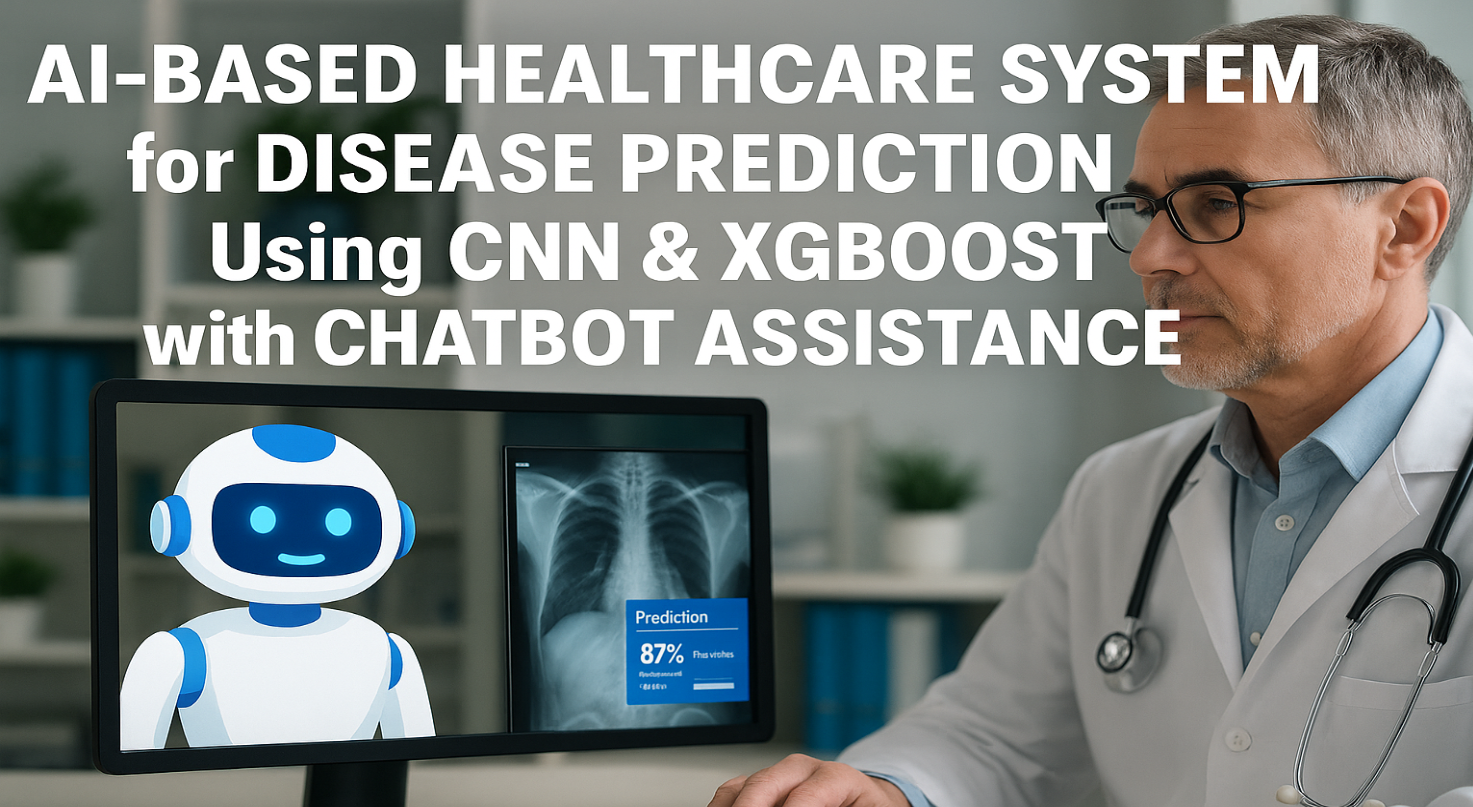
This project presents an AI-powered healthcare platform that integrates lung cancer prediction, skin disease detection, and a natural language chatbot for patient assistance. It leverages machine learning models including XGBoost and Convolutional Neural Networks (CNN) to analyze both tabular and image data. Additionally, a chatbot trained using NLP and Random Forest enhances user engagement by answering health-related queries in real-time. The system aims to improve early disease detection, reduce clinical workload, and make healthcare services more accessible and intelligent.
Introduction
Early detection and timely consultation are key factors in reducing mortality rates in diseases like lung cancer and skin conditions. However, lack of access, awareness, and medical infrastructure delays diagnosis. This AI-based system is designed to bridge that gap by offering predictive and diagnostic tools, along with an AI chatbot, to guide patients effectively. It combines medical data processing with machine learning for efficient, interactive, and scalable healthcare assistance.
Problem Statement
Manual diagnosis is time-consuming, dependent on medical personnel, and prone to human error. Patients often have limited access to timely consultation, especially in remote areas. There is also a communication gap where users hesitate or are unable to ask health-related queries without appointments.
Existing System and Disadvantages
– Manual consultation and lab-based diagnosis
– Generic chatbot systems with predefined rules
– Separate tools for prediction, detection, and patient Q&A
Disadvantages:
– Delayed diagnosis and limited scalability
– No integration of prediction/detection and chatbot
– Inflexible Q&A systems with low accuracy
– High dependency on specialist availability
Proposed System and Advantages
An integrated healthcare system that combines:
– Lung cancer prediction using XGBoost (tabular data)
– Skin disease detection using CNN (image data)
– An intelligent chatbot for answering user health queries using NLP
Advantages:
– Fast and accurate predictions
– Automated image-based skin disease classification
– Real-time, AI-driven chatbot communication
– Accessible from any device with a browser
– Scalable and user-friendly for both patients and healthcare providers
Modules
1.Lung Cancer Prediction Module
– Input: Patient data form
– Model: XGBoost Classifier
– Output: Prediction of cancer risk (Yes/No)
2. Skin Disease Detection Module
– Input: Uploaded skin image
– Model: CNN
– Output: Detected disease label
3. Chatbot Assistance Module
– Input: Patient queries in natural language
– Model: NLP + Random Forest
– Output: Intelligent, trained health response
✅ Modules in Detail
Lung Cancer Prediction Module
Input: Patient tabular data (age, smoking status, symptoms, etc.)
Model: XGBoost Classifier
Output: Binary prediction – whether lung cancer is likely (Yes / No)
Features:
Form-based manual data input
Model trained on real medical dataset
Live prediction using trained model
Integrated into the Flask web application
Skin Disease Detection Module
Input: Uploaded skin image
Model: Convolutional Neural Network (CNN)
Output: Detected disease class (e.g., Impetigo, Cellulitis, Ringworm)
Features:
Image pre-processing and classification
CNN model trained on labelled image dataset
Displays disease name, not just numeric label
Fully embedded in the web system
Chatbot Assistance Module
Input: Patient natural language query
Model: TF-IDF + Random Forest
Output: AI-generated answer from trained dataset
Features:
Pattern-based training using tag, patterns, responses format
Answers queries about lung cancer, skin conditions, treatment, symptoms, etc.
Embedded as a floating widget on the site (non-intrusive, real-time)
User Management Module
Includes: User Registration, Login, Authentication
Features:
Secure MySQL-backed login system
User form validation and session routing
Separate access for patients and admin
Admin Dashboard Module
Features:
Default admin login (username: admin, password: admin)
View all registered users
View and manage user feedback
Potential for expanding into doctor/appointment management
Feedback / Review Module
Input: Feedback or suggestion submitted by the user
Database: Stored in feedback table in MySQL
Features:
Simple textarea interface
Stores feedback with user IDs or anonymously
Viewable through admin dashboard
Algorithms Used:
– XGBoost Classifier – For high-accuracy lung cancer prediction from structured patient data
– Convolutional Neural Network (CNN) – For detecting skin diseases from image input
– TF-IDF Vectorizer + Random Forest – For chatbot NLP training
Software and Hardware Requirements
Software:
– Python 3.x
– Flask Web Framework
– TensorFlow / Keras
– Scikit-learn
– HTML/CSS/JavaScript
– Joblib, Pandas, Matplotlib
Hardware:
– Standard PC with 4GB+ RAM (development)
– GPU recommended for CNN model training
– Hosting server for deployment (optional)
Conclusion
The proposed AI healthcare system effectively integrates prediction, detection, and consultation into one platform. It enhances the accessibility and efficiency of healthcare services, especially for those with limited access to doctors. Its modular design ensures flexibility for future disease models and multilingual chatbot expansion.
Using XGBoost for lung cancer improves classification accuracy and robustness compared to traditional classifiers.
Future Enhancements
– Deploy chatbot with voice interaction (speech-to-text APIs)
– Add multilingual support to chatbot
– Expand dataset for more disease predictions
– Include doctor consultation scheduling module
– Mobile app integration for remote monitoring



Reviews
There are no reviews yet.